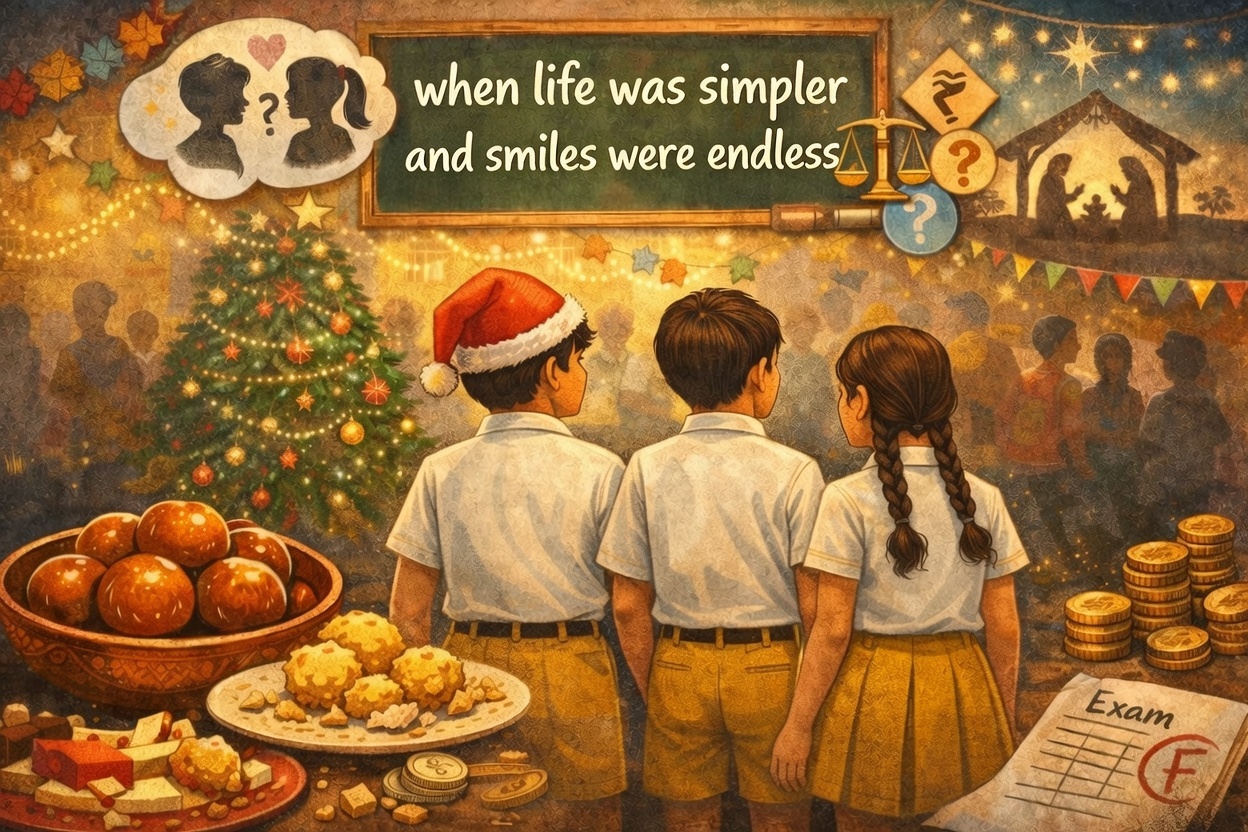

A Christmas party, a plate of sweets, a rigged lottery, and lessons no textbook ever taught.
“You live and learn. At any rate, you live.”
— Douglas Adams
Christmas at Crescent is not an event; it is an experience. It is the one day when students stop worrying about exams and start worrying about whether the gulab jamuns will be ready on time.
First, the timing: the school could have ruined the tradition like it ruined so many others—by scheduling the party two days before exams. But thankfully, Jesus was born on the 23rd of December, and even Crescent couldn’t reschedule the birth of Christ to fit the academic calendar.
A Crescentian and vanity never go hand in hand.
Of course, it is said that trying to be completely free of vanity is itself a form of vanity—we can “digress” into that later. But there is a far more practical reason why Crescentians cannot be accused of being vain.
In the rest of the world, whenever teenagers are supposed to go to a party, they fuss over their clothes, how they will look, whether “red” is the “in” colour or not, who will be their vibe company, and so on. But a true-blood Crescentian is above all this vanity, because the core principle that drives a party at Crescent is sharing.
The principle is simple: students are divided into groups, each group is assigned an eatable, and everyone is expected to bring their contribution from home. As a result, on the morning of the party, students are no longer tense about their clothes or hairstyles. Instead, the dominant anxiety is whether the gulab jamuns have been fried properly and whether the ladoos have set in time.
And that’s when the real education began:
Lesson #1: Generalisation May Lead to Prejudice
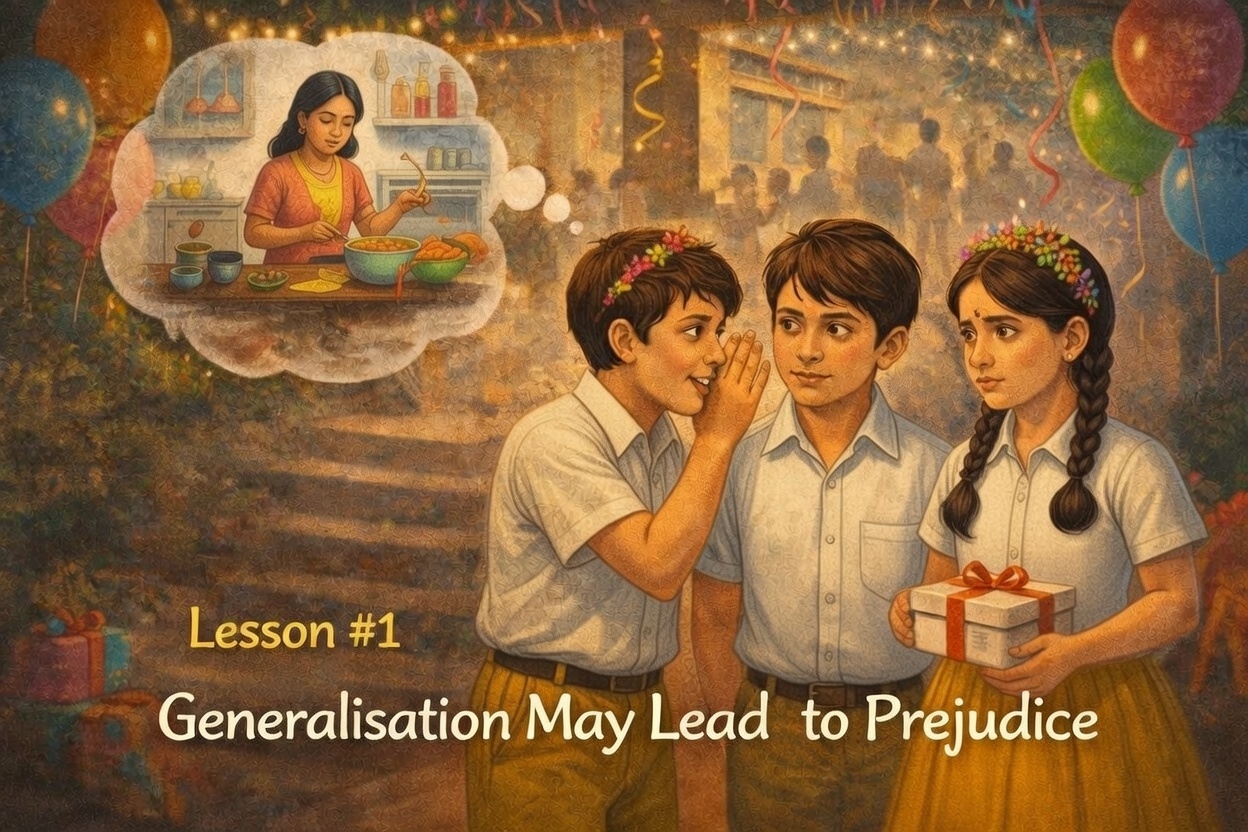
The first lesson one learns is that generalisations are dangerous. Take the classic generalised statement: “All women are bad drivers.” This, of course, is completely untrue—mainly because some boys are equally bad drivers.
The same principle applies to the Christmas party. You cannot simply declare, “Oh, the gulab jamuns are bad.” You really cannot. Ten people have brought a hundred jamuns from ten different kitchens. Once they are mixed together, no one knows which jamun came from where. Judgment, at this point, becomes both unfair and pointless.
Ironically—or perhaps appropriately—while consuming a particularly suspicious jamun, a friend in my class began singing, “Nadi mile sagar mein, sagar mile kaun se jal mein, koi jaane na.”
At that moment, philosophy, Bollywood, and bad cooking achieved perfect harmony—and prejudice quietly lost its argument.
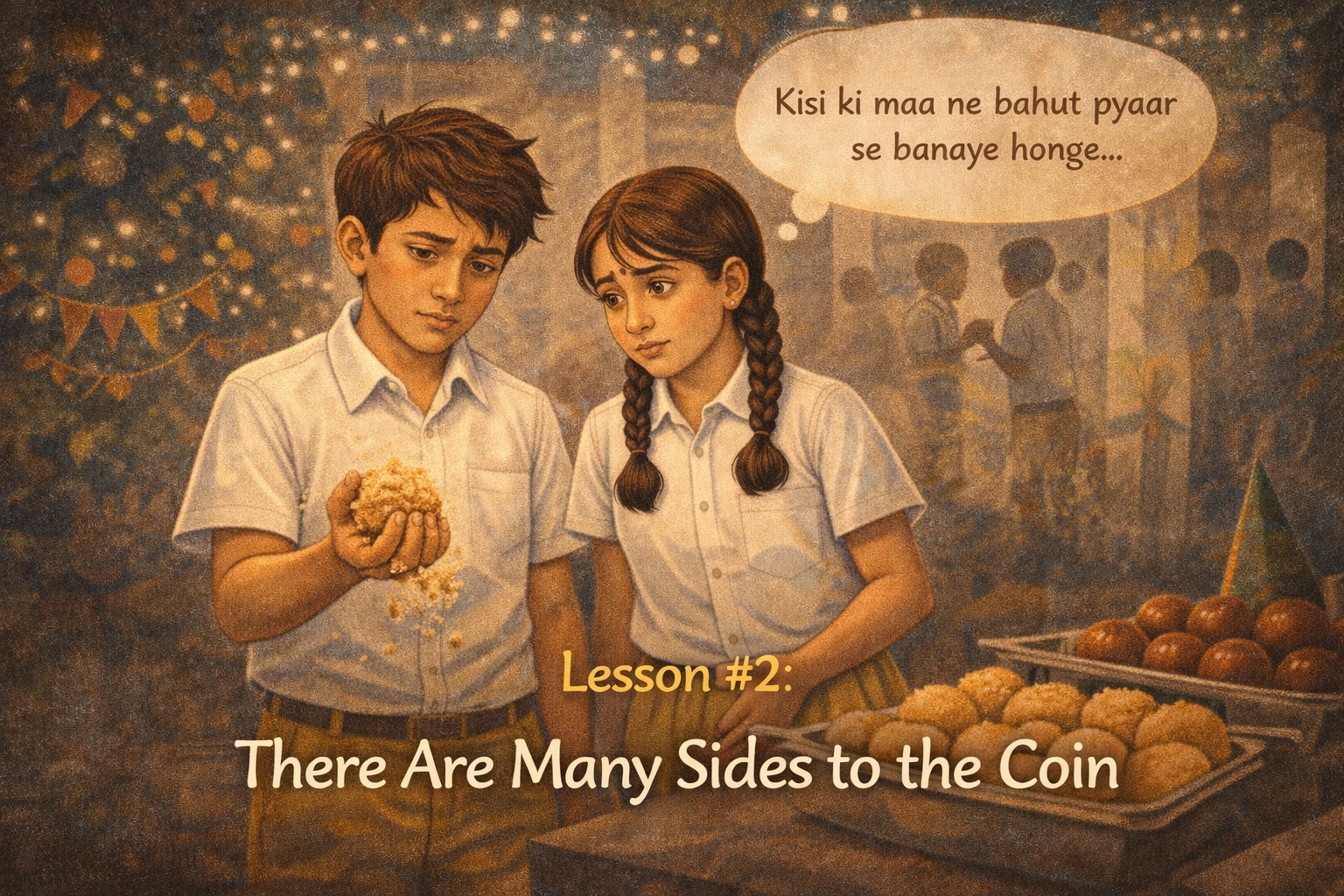
Lesson #2: There Are Many Sides to the Coin
If Lesson #1 taught us that judgment is dangerous, Lesson #2 teaches us that… well, it teaches us something—not sure what it is.
I have seen people—not Haley Joel Osment in The Sixth Sense—just normal people, walking around with tags that say “Happy Thoughts” pinned to their pockets or collars. I strongly suspect that whoever started this trend must have been a Crescentian. No other institution trains you so effectively to expect the best, even when all evidence suggests otherwise.
At the Christmas party, after surviving the gulab jamuns, you may discover—through a friendly investigation—that the ladoos are good. Encouraged by this revelation, you approach them with hope. You take one gently in your hand. You close your eyes. You imagine a moment of pure bliss.
And just as the ladoo is about to touch your wide-open mouth—it crumbles.
Not metaphorically. Not partially. It disintegrates completely. All that remains is a mess on your hand, your clothes, and your mind. Just as you are about to express feelings that cannot be printed in a school magazine, someone nearby offers a comforting explanation:
Kisi ki maa ne bahut pyaar se banaye honge, isliye itne soft ho gaye hain.
At this point, you are unsure whether to appreciate the sentiment, question the cooking, or reflect on the emotional fragility of sweets. Personally, I chose silence.
At moments like that, you realise Prasoon Joshi—lyricist of all those heart-melting “Maa” songs—must have been channelling his inner Crescentian, either from this or a past life
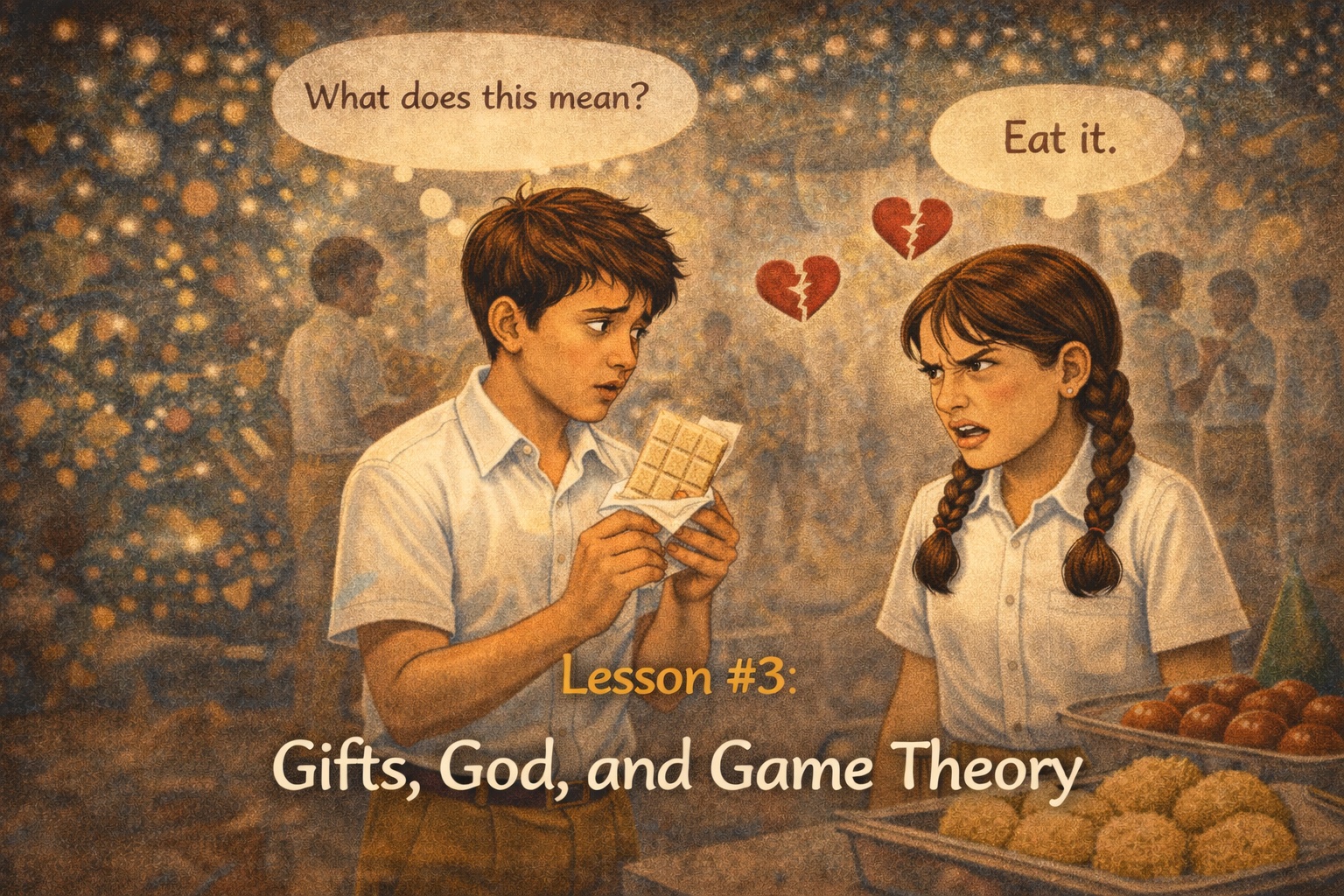
Lesson #3: Gifts, God, and Game Theory
If sweets teach us philosophy, gifts teach us economics—and occasionally destiny and romanticism. Economics, being the sister of mathematics, involves calculations. So let us postpone that and focus on romance and destiny.
Just as the food-sharing principle arose from the reluctance of Crescent to arrange food for its students, Crescent also followed a unique path when it came to Christmas gifting. The tradition is simple. Every student brings a gift. A lottery based on roll numbers decides which roll number’s gift goes to which roll number. Since Crescent failed to copyright this tradition, the West hijacked it and rebranded it as “Secret Santa.”
On paper, this appears fair. In practice, it is an emotional minefield.
Hilarity in this minefield explodes when eager students—mostly boys—get a gift from their Person of Interest (POI). This gift, regardless of its utility, becomes the means to approach the POI with questions about its meaning.
Some remain calm and go ahead with simple conversation starters such as, “Thank you for the gift.”
Some attempt a slightly bolder approach like, “Thanks for the watch—it is cool, but is it a hint that it is time for us to talk more?”
Some shy souls cannot muster the courage and retreat altogether. However, one of my friends took this concept to the extreme.
The gods of destiny (from a rigged lottery, mind you) delivered him a large white chocolate from his POI. In complete gumshum, this chocolate hero of ours approached her with a very Bollywood-esque question: “What does this mean?”
He believed that getting a chocolate from her was a “sign” from the “kayenaat” that they should be together—and that she should also see the signs and reciprocate. (Guilty as charged—we are a generation of hopeless romantics. After all, we are the generation that gave Karan Johar his first hit and brought real suffering upon millions of fellow Indians.)
A loud “Eat it!” ended the romantic saga.
“Eat it. That’s what it means. Eat it, finish it, and if you can’t, share it with your friends.”
Needless to say, our hero lost his appetite and couldn’t eat the chocolate after all. It was a very nice white chocolate—mild, not loaded with milk solids, not too sweet, of the right consistency, neither too soft to crumble nor too hard to make chewing a task.
Now, enough of this daily-soap drama. Let us move on to serious matters.
The greatest lesson hidden in the gift exchange was not about romance or divine signs. It was about game theory.
Long before most Crescentians heard of John Nash or A Beautiful Mind, they were already solving his most practical problem:
If I buy a gift worth ₹30 and receive one worth ₹20, I am at a loss.
If I receive one worth ₹40, I am in profit.
But if my gift looks too cheap, I risk ridicule—and that loss is permanent.
The challenge, then, was to choose the perfect equilibrium. It required market research, discreet opinion polls, and the ability to read faces without revealing one’s own hand.
The genius minds solved the problem elegantly.
They bought a gift for ₹15, made it look like ₹30, received one worth ₹25, and declared graciously, “Arre saab, friends hi toh hain—thoda aage-peeche ho gaya toh kya hua.”
A net profit of ₹10, accompanied by the public appearance of generosity. Nash would have approved.
As in life, so at the party: some go home happy, with dreamy eyes replaying conversations with their POI (these people eventually married the person chosen by their parents); some are proud of having made a profit in the gift exchange (today, they are powerful brokers on the Bombay Stock Exchange); some remain confused about whether they made a profit or a loss (today, they are engineers working in IT firms, still wondering whether they earn more than the market or less); and some introverts go back thinking, “I should have said this or that” (these people are now part of the bureaucracy, getting all their best ideas after retirement).
Oh yes, there is also the lone Christian student, for whom the occasion carries theological significance. The rest of us—Maharashtrians, Marwadis, Gujjus, Sikhs, Mallus, and occasionally Somalians, Australians, and Europeans (a minor exaggeration, in the spirit of Christmas)—simply join in. Because that day, we are just children enjoying ourselves with our teachers in the same room. No books are opened, no homework is checked, no tests are answered, no results are announced—just pure enjoyment.
I can tell you from experience: getting a bad jamun or a crumbling ladoo is far better than getting bad marks in your English paper—and then crumbling in front of your parents while explaining how those marks were not your fault.